Health & Wellness
How to Read an InBody Result Sheet: A Clear Guide

For your understanding.
This article is for general education and is not medical advice. It does not replace an individual assessment or guidance from a qualified healthcare professional.
To read an InBody Result Sheet, first check the date, units and testing conditions. Then review weight, skeletal muscle mass and body fat together, followed by the history of comparable tests. The report provides estimates to discuss; it is not a health grade or a diagnosis.
Allura uses the InBody 380. The layout below is a manufacturer example, and the fields on an individual report can vary. Start with the sections you have rather than assuming every metric shown online is included in your visit.
Start with the right report and a clear example
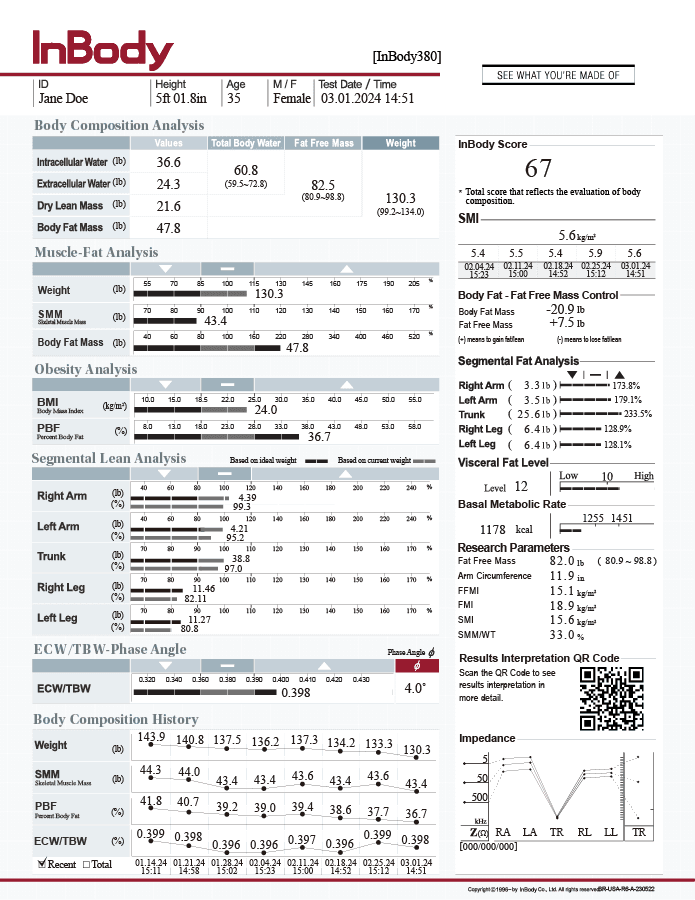
Open the full-size manufacturer example to follow the section names. InBody’s 380 product information explains that some outputs and history fields are customizable. This sample does not establish the configuration of every report.
Before looking at the bars, confirm the test date and recorded height, and check the weight units. Ask the team to correct any identifying or entered information that appears wrong. Comparing a new reading with the wrong earlier record can create a misleading story before interpretation even begins.
Read the main numbers together
InBody’s body-composition explanation describes how bioelectrical impedance uses electrical measurements to estimate body water and other components. Treat the outputs as related estimates, rather than several independent confirmations of the same conclusion.
| Field | How to read it |
|---|---|
| Weight | Your measured body weight. Check whether the report uses pounds or kilograms before comparing it with another record. |
| SMM | An estimate of skeletal muscle mass. It is not all fat-free mass, and it is not a measurement of strength. |
| Body Fat Mass and PBF | Fat mass is an estimated amount in weight units. Percent Body Fat expresses that amount as a share of total weight. |
| Total Body Water and Fat Free Mass | Water is part of fat-free mass. A change in the non-fat component should not automatically be called new or lost muscle. |
| BMI | A weight-for-height index. It is a different calculation from body-fat percentage and does not directly measure body fat. |
For example, a lower body weight and lower muscle estimate do not explain their own cause. Ask whether conditions were comparable and whether the change is consistent with the wider history. Avoid deciding that a plan succeeded or failed from one isolated value.
Muscle quantity is not the same as strength
Skeletal muscle mass, fat-free mass and strength answer different questions. Someone can have a concern about everyday function that is not explained by a composition number alone. The European consensus on sarcopenia places muscle strength at the center of assessment and considers muscle quantity and performance separately.
That does not mean you should diagnose muscle loss from a report. Bring difficulties such as changes in lifting, walking or getting out of a chair into the discussion with a qualified professional. The article on preserving muscle during weight loss explains why nutrition, training and function belong in the broader conversation.
What does segmental lean analysis mean?
This section organizes lean estimates by the arms, trunk and legs. Check the label beside each bar: the comparison may relate to a reference weight or your current weight. A percentage is not a direct test of how strong that limb is, and a difference between sides does not diagnose an injury.
Use the manufacturer’s Result Sheet guide to identify the section, then ask what comparison is being shown on your own version. Do not turn a bar into a prescription to train one side harder without an appropriate assessment.
Use optional fields as questions, not prescriptions
A 380 report may also display ECW/TBW, phase angle, a visceral fat level, an InBody Score or a basal metabolic rate estimate. These outputs have different purposes. They are not interchangeable measures of health, and not every configuration shows the same set.
- ECW/TBW describes the extracellular share of total body water. A flag does not establish the cause of a fluid change.
- Phase angle and visceral fat estimates need context; they do not independently diagnose disease.
- An InBody Score summarizes aspects of the composition output, not overall health, fitness or personal effort.
- Basal metabolic rate concerns energy use at rest. It is not automatically a daily eating target or a safe calorie prescription.
For perspective, the NIDDK Body Weight Planner considers activity and other information when estimating energy needs. A single report value cannot supply a complete nutrition plan. Likewise, a suggested fat or lean-mass adjustment on a printout is not an instruction to make that change on your own.
Compare trends under similar conditions
Look at the history only after checking whether meals, exercise, hydration, timing or recent heat exposure differed. The InBody preparation checklist explains what to record. A one-visit difference is a starting point for questions, not proof of a lasting tissue change.
Useful follow-up questions include: Which change appears consistent over time? What was different on the testing day? Does the pattern fit my function and routine? Would a repeat test help, or does a symptom need clinical assessment instead? There is no need to choose a supplement, calorie target or treatment simply because a bar sits outside a reference range.
For the local assessment and report discussion, see Allura’s InBody 380 service. If your broader goal is healthy aging, the guide to healthy aging after 40 connects composition information with the everyday habits and questions that matter beyond a single report.
Your next step
Make your next InBody visit more useful.
Book a body-composition visit at Allura in North Miami Beach. Bring your previous results and report questions to discuss with the team.
InBody measurements are estimates, not a diagnosis or a supplement prescription. Individual guidance helps put the numbers in context.